
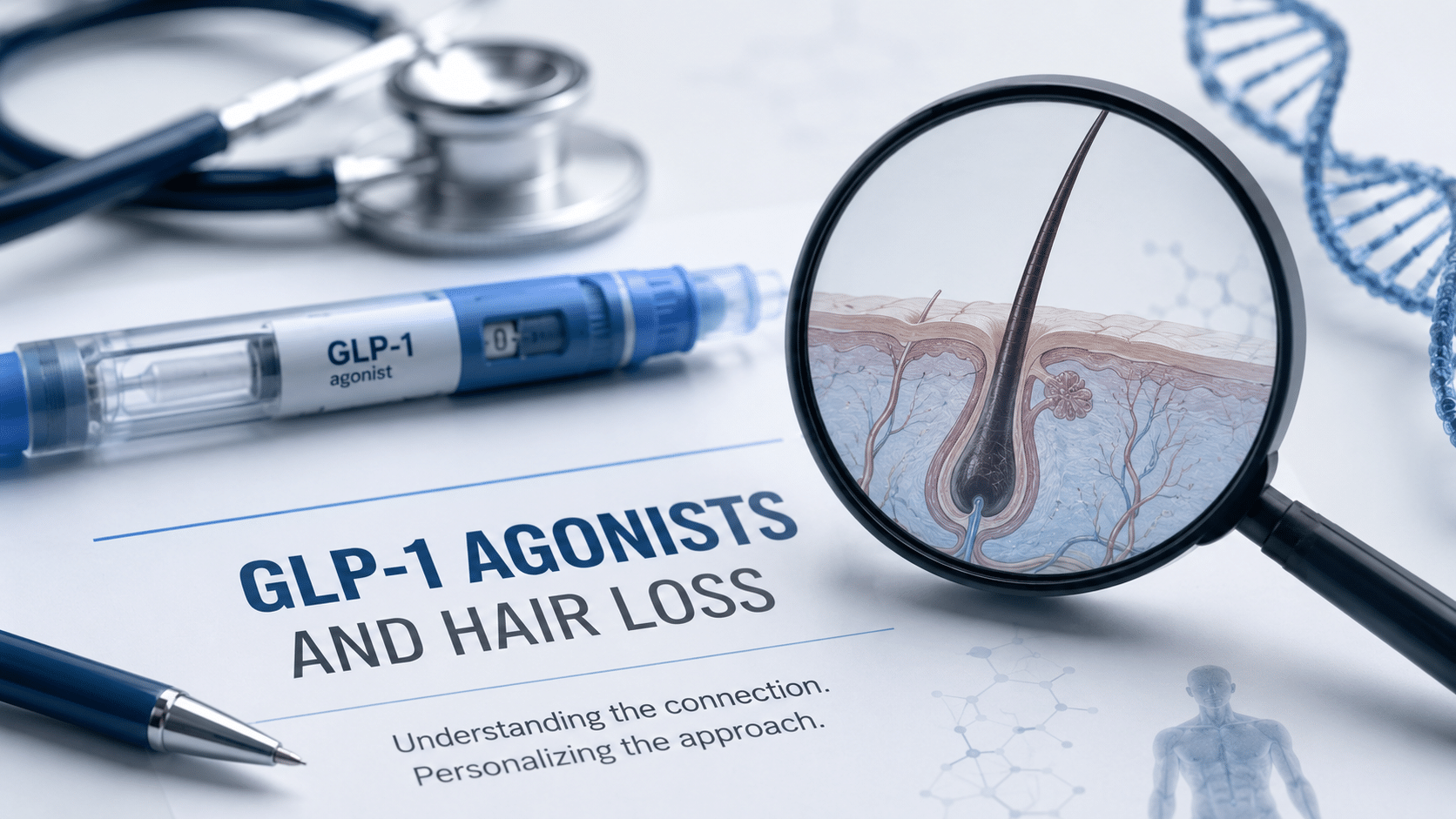
Can GLP-1 agonists be associated with hair loss? Drugs such as semaglutide and tirzepatide, which belong to the class of GLP-1 receptor agonists, are increasingly used to treat type 2 diabetes and obesity. Their effectiveness in controlling blood sugar and reducing body weight is well documented. However, as their use has become more widespread, reports are emerging of possible dermatological side effects, including increased hair loss.
A recent multicenter study based on real-world clinical data analyzed the relationship between the use of GLP-1 agonists and the onset of alopecia: the results do not show that these drugs inevitably cause hair loss, but they suggest that, in some individuals, the treatment may be associated with an increased risk.
https://pubmed.ncbi.nlm.nih.gov/41858311
The study used the U.S. TriNetX database, which collects anonymized health data from 67 healthcare organizations, comparing patients treated with GLP-1 agonists to those not exposed to these medications, while balancing the groups for important characteristics such as:
- age;
- gender;
- ethnic origin;
- body mass index;
- presence of type 2 diabetes.
The main analysis included 547,993 adult users of GLP-1 agonists, compared with a control group. The authors evaluated various forms of hair loss:
- telogen effluvium;
- androgenetic alopecia;
- alopecia areata;
- General non-scarring hair loss.
Six months after the start of the study, the use of GLP-1 agonists was associated with an increased likelihood of androgenetic alopecia and overall non-scarring hair loss. At 12 months, the association was more evident:
- telogen effluvium: a 76% increase in probability;
- androgenetic alopecia: a 64% increase in the likelihood;
- Overall non-scarring hair loss: a 40% increase in the likelihood.
However, no significant association was observed with alopecia areata, a predominantly autoimmune form of alopecia.
Why might GLP-1 medications affect hair physiology?
The relationship between GLP-1 agonists and hair loss may be due to several mechanisms, which likely act in combination.
1. Rapid weight loss — A significant and rapid reduction in body weight places metabolic stress on the body. In some people, this change can disrupt the normal hair follicle cycle, causing more hair to transition from the growth phase to the resting phase and subsequent shedding. This phenomenon is known as telogen effluvium and may occur several months later:
- rapid weight loss;
- very restrictive diets;
- surgical procedures;
- fever or systemic illnesses;
- periods of intense physical or psychological stress.
In these cases, hair loss tends to be widespread rather than confined to a single area of the scalp.
2. Nutritional imbalances – The reduction in appetite caused by GLP-1 medications can lead to an insufficient intake of certain nutrients essential for the hair follicle, especially when weight loss is not accompanied by adequate nutritional monitoring. Nutrients important for hair health include:
- proteins;
- iron;
- zinc;
- vitamin D;
- vitamin B;
- essential fatty acids.
A nutritional deficiency is not necessarily the primary cause of hair loss, but it can contribute to making it more severe or prolonged.
3. Metabolic and Hormonal Changes – GLP-1 agonists influence insulin metabolism and numerous biological signals involved in energy regulation. The study authors hypothesize that the insulin/IGF-1 systems, androgen balance, and, potentially, certain direct mechanisms of the hair follicle may also be affected.
These hypotheses have yet to be confirmed by prospective studies and research specifically focused on biological mechanisms.
Why don’t all users of GLP-1 agonists lose their hair?
The same medication and the same amount of weight loss do not produce the same effects in everyone. The response depends on the interaction of numerous factors:
- the rate and amount of weight loss;
- baseline nutritional status;
- age and gender;
- hormonal balance;
- the presence of stress or concomitant medical conditions;
- scalp health;
- family history of alopecia;
- individual genetic predisposition.
Genetics can influence a follicle’s sensitivity to androgens, the duration of the various phases of the hair cycle, its response to oxidative and inflammatory stress, and its ability to utilize certain nutrients that are important for hair structure and growth.
A person predisposed to androgenetic alopecia, for example, may have hair follicles that are more sensitive to hormonal signals. A period of severe metabolic stress, such as rapid weight loss, could therefore bring to light a condition that had previously been barely noticeable.
This does not mean that genetics currently allow us to predict with certainty who will develop alopecia during treatment with GLP-1 agonists. The published study did not directly analyze genetic variants and does not identify specific markers capable of predicting this adverse effect.
However, understanding an individual’s predisposition can help paint a more complete picture by taking into account family history, clinical characteristics, lifestyle, nutrition, and personal response to metabolic changes.
What to Do Before and During Treatment
GLP-1 agonists should not be discontinued on one’s own due to hair loss. The metabolic and cardiovascular benefits of treatment can be significant, and any change in therapy must be evaluated by a doctor. If you have a predisposition to hair loss or a strong family history of it, it may be helpful to take certain precautions:
- document the initial condition of the hair and scalp;
- check your weight and the rate of weight loss periodically;
- ensure an adequate intake of protein and micronutrients;
- assess any deficiencies through tests prescribed by the doctor;
- detect changes in density or an increase in hair loss at an early stage;
- Seek a dermatological or trichological evaluation if the problem persists.
The goal is not to cause alarm, but to identify the most vulnerable individuals early on and support their treatment with a personalized care plan.
Toward a More Personalized Approach
The new study reinforces an increasingly important concept in modern medicine: the same treatment can produce different results and effects from person to person.
Knowing one’s genetic predispositions is no substitute for a medical evaluation and, on its own, does not allow for a definitive diagnosis or prediction of future hair loss. However, it can provide useful information about the biological processes that contribute to follicle health and help in developing more informed strategies for prevention, nutrition, and monitoring.
When undergoing a treatment that can lead to significant changes in metabolism and body weight, gaining a better understanding of one’s individual characteristics can serve as a starting point for protecting not only one’s overall health but also the health of one’s hair.
Conclusion
Currently available evidence suggests an association between the use of GLP-1 agonists and an increased risk of certain forms of non-scarring hair loss, particularly telogen effluvium and androgenetic alopecia.
Not all treated individuals develop this problem, and it is not yet possible to determine precisely who will be at greater risk. It is precisely this variability that highlights the importance of considering individual predisposition, family history, nutritional status, and genetic characteristics.
Understanding your strengths and vulnerabilities in advance allows you to approach weight loss and metabolic changes with greater awareness, identifying personalized strategies to support hair health.
The study cited is an observational study based on retrospective clinical data. The observed association does not demonstrate a direct causal link between GLP-1 medications and alopecia. Prospective studies are needed to clarify the mechanisms involved and identify any individual predictive factors.
Would you like to learn more about your predisposition to hair loss? Discover InGeno|Hair >>>

